Languages
0-6 month
 

Recommended exercises for ages 0 – 6 months:

Examples for exercises that will help you, the parents and care takers, to reach the full potential of the GYMBOX.
The parent is responsible for the correct performance of the exercises.
No exercise should be attempted without the will and the cooperation of the infant.
All the precautions that are specified on the label that is glued to the product must be followed.
It is forbidden to play with the product or climb on it without adult supervision.
While in use, the Gymbox must be placed on a carpet or soft surface.


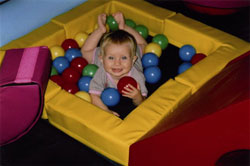
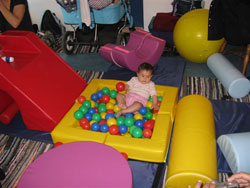
Balls pool
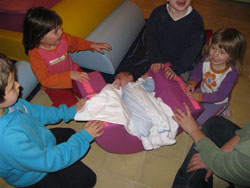
Lay the baby inside the balls pool on its back or on its stomach according to the following option
Ages 0-3 months: no balls in the pool/ few balls in the pool/ with a soft toy/ with a ball at the rim of the pool.
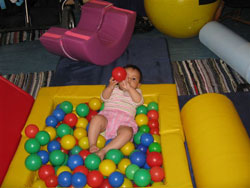
Ages 3-6 months: more balls can be placed in the pool.
 
Exercise No. 1
Take a ball from the pool and gently move it along the outline of the baby's body, while naming each body part as the ball touches it.
 
Exercise No. 2
Let the baby feel the ball/ catch it/ move it from one hand to the other – according to the baby's stage of development.
 
Exercise No. 3
Show the baby how you roll the ball; let it follow the ball as it rolls.
 
Exercise No. 4
Let the baby lie in the pool in different positions and study the environment – play soft and soothing music and maintain eye contact with the baby.
 
Exercise No. 5
Ages 3-6 months: while the pool is filled with balls, lay the infant on its back and move it gently on the balls back and forth and from side to side.
 
 
Exercise No. 6
Ages 3-6 months: lay the infant on its stomach on the slide with its head towards the pool; hold it and encourage it to play with the balls with its hands. Repeat the same exercise, this time with the infant's legs towards the pool and playing with its feet.
 
Developmental contribution:
Familiarity with the outline of the body, familiarity with the environment, the pool and the balls create motion sensation and senses stimulation that help developing rolling over and crawling skills in the future. Following a ball as it moves, catching it and later rolling it, help the development of eye - hand coordination.


Various accessories for balance
 
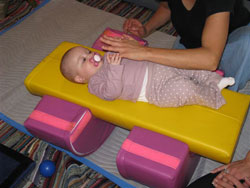
A seesaw made from two pink half circles and yellow half cylinder/ yellow half cylinder/ blue half cylinder
 
Exercise No. 1
Lay the baby on its back or on its stomach, and rock it gently. Change the baby's position while checking in which position it is most comfortable.
 
Exercise No. 2:
Give the baby a ball to hold / encourage the baby to grab the ball by itself.  
 
Exercise No. 3
Lay the baby on its stomach and place the ball in front of its eyes/ let the baby follow the ball while gently rocking it.
 
Balancing plane
 
Exercise No. 4
Lay the baby on its back or on its stomach and rock it gently while changing positions. If you feel that the baby likes being rocked, you can rock it while changing speed and sudden stops.
 
Exercise No. 5
Rock the baby gently up and down and in circular motions.
 
Exercise No. 6
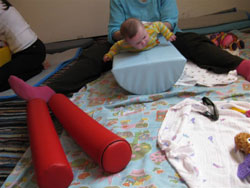
Gently insert the small red cylinder under the baby's thorax; this will encourage the infant to raise its head and strengthen its neck muscles and shoulder girdle.
 
A seesaw combining the two pink semi circles
 
Exercise No. 7
Lay the baby on its back, (could be done in a cradling motion) and rock it gently.
 
Developmental contribution
Balancing skills are important to the development body control sensation, and are necessary for rolling over efficiently and later for crawling correctly and orderly until the transition to sitting, standing and walking. Balancing exercises require the babyto stabilize and hence contributing to achieve a balanced muscle tonus. Lying on the stomach in different positions encourage the baby's motion development. Raising the head helps strengthening the baby's neck muscles and shoulder girdle. Different babies like different balancing positions, try to find the feature that the baby feels most comfortable in and continue to introduce it to the other features. Diversify the exercises for the baby. 


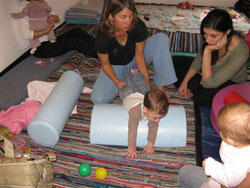
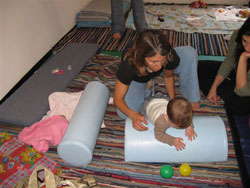
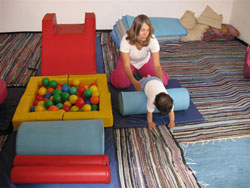
  Cylinder/ half cylinders - from 3 months onwards

 
Exercise No. 1
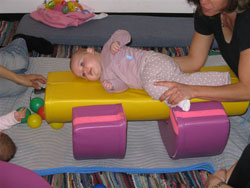
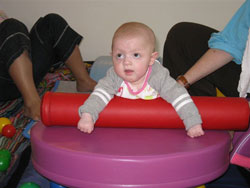
lay the baby on the cylinder, its thorax and stomach touching the cylinder; move the baby back and forth so that its weight rests on its hands and then back on its knees.
 
Exercise No. 2
lay the baby on the cylinder and roll it back and forth. Place toys in different distances from the cylinder so that the baby will reach out for the toys and grab them.
 
Exercise No. 3
Some babies need more maneuvering space. Place the smaller blue semi circle on top of the bigger yellow one. In this position place the baby on the smaller blue semi circle and rock it gently. Perform this exercise both with the baby lying at the center of the cylinder and on different sides to practice leaving one hand (a different hand each time).
 
Exercise No. 4
lay the baby in front of the cylinder and encourage it to push and to knock the cylinder over with its feet.
  

Developmental contribution
Exercises that include lying on the stomach develop the sensation in the areas at the front of the body (the belly, the chest and the thorax).
Developing this sensation is very important and encourages motion development, weight transfer motions is preparation for standing on hands and knees before crawling and strengthening the shoulder girdle. Strengthening the shoulder girdle is very important for the Moro reflex. This reflex takes effect when the baby losses its balance.
The baby learns that in situations when its head is moving downwards it should spread its hands to the sides to prevent falling.
If the baby does not spread out its hands (in a cushioning motion) the exercise should be repeated several times until the infant clearly learns to connect between receiving the information and the reaction.
The different cylinders allow personal adjustment to every baby, to practice weight shifts from side to side.


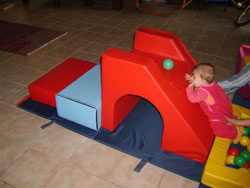
 (Slide (slope
 
 
Exercise No. 1
Sit on your knees at the bottom of the slope, and place the baby on his hand and knees on the slope with its head on the top and its legs at the bottom of the slope, with its sheens resting on and supported by your legs. Hold the baby at the pelvis area and help the baby gently to move back and forth. This motion is performed better and easier on the slope than on the ground because gravity helps the baby to move. The baby learns the move and after several repetitions can perform it on its own. This movement helps with the transition to crawling on hands and knees.
 
Exercise No. 2
Using the same position as in exercise No. 1 roll a ball down from the top of the slope.  At first the baby will watch and follow the ball, later it will try to catch it.
 
Exercise No. 3
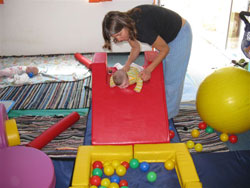
lay the baby on the top ramp of the slide, and move it slowly and gently forward until it rests on its hands. Hold the baby under its stomach and lift its entire body except of its hands so that it reaches wheelbarrow stand (very important for strengthening the shoulder girdle).
 
Exercise No. 4
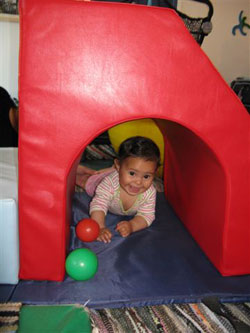
lay the baby next to the slide, by the tunnel, and gently roll balls towards the baby through the tunnel.
 
Exercise No. 5
lay the baby on the top ramp of the slide, and give it a ball to hold and to roll down the slope to the balls pool.
 
Developmental contribution
Develops the sensation in the front areas of the body, encourages motion development, weight transfer motions as preparation for standing on hands and knees before crawling and strengthening the shoulder girdle and Moro reflex. Following the balls develops the baby's eye – hand coordination.
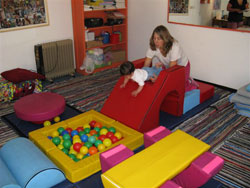


Peek- a- boo games

 
Play peek a boo with the baby in different places and using different features of the GYMBOX mattress. The baby follows you and tries to find out where the peek a boos are coming from.
 
Exercise No. 1
Sit in front of the baby and use hide your face with the cylinder. Peek and call the baby alternatively.
 
Exercise No. 2
lay the baby next to the slide, by the tunnel, and hide behind the slide. Peek and call the baby alternatively.
 
Exercise No. 3
Attach the two pink half circles together to make a whole circle (hoop). Hide your face behind it and peek from the hole (peek a boo).
 
Developmental contribution
Peek -a -boo is known as babies' first social game. The baby enjoys a repetition game in which the significant adult disappears and re-appears. Playing this sort of games the baby learns the first social rules: dialogue, asking "peek –a- boo" the baby learns to wait and then to receive the answer, "boo". Playing peek- a- boo help developing circular motion - rotations, (in which some part of the body is moving relatively to the rest of the body), when the baby turns around to look for the parent. In the first months of the baby's life it moves its entire body as a bulk, and separating the movements of different body parts is essential to refine the movement and to make it effective. In order to crawl, to sit, to stand and to walk successfully the child must learn to separate the different body movements and not to move the body as a whole.       


Print Version Print Version       Send to a friend Send to a friend      


© all right reserved Gymbox ltd. 2008  Patent pending 2007  |  Created By Kinderland