Languages
Develop and enjoy
 

It is important that quality time of the parent and baby in the first year   include also physical activity that encourages the motor development, coordination and equilibrium. So you will help the little ones to move.

By: Dana Alperon, psychologist, Developmental and educational consultant to the GYMBOX. 
Consultation and exercises: Orna Elad, feldenkreis teacher and and developmental accompaniment to the preschoolers.

Experimentation  in a variety of motor activities contributes to the development of the baby, Reinforces his confidence and his Social and emotional skills and provides hours of quality time of parent and baby  an additional value of promoting the developmental capabilities while playing and having fun. Various areas of development are interrelated.
Motor development begins in the development of the control of the rough muscles: Neck muscles, shoulders, arms and legs, and moves to control the fine muscles, such as the finger muscles. Through the motion and the experimentation with various senses the infant develops also the thinking, language and the concepts of the child.
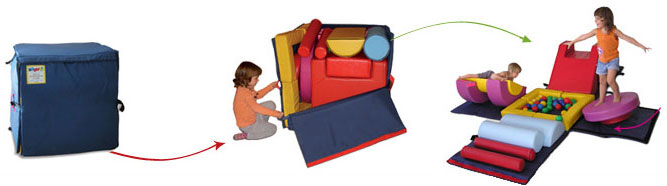
Nursery equipment market offers quite a few accessories and babies activity surfaces, the following exercises are designed to perform on the GYMBOX -   motor activity centre for the domestic environment. This modular cube unfolds to six edges and becomes a sport mattress that combines various elements, such as balls pools, cylinders of different sizes, swings, stairs, slope to the climbing and sliding, crawling tunnel and balance surface. 
Motor activities include crawling  through narrow passages, decline and climbing  on   steps of large building cubes, climbing and sliding the slide, maintaining the balance, ball games : throwing, catching, rolling , etc.   The more the babies   experience more so they will improve their abilities to more qualitative complex and coordinated movements.  In addition to the development and to the improvement of gross motor skills, the babies will achieve other important skills such as visual and spatial perception, fine motor skills, and eye – hand coordination and development of body image   and thinking. Every baby has a different development rate. The  proposed exercises suitable for babies aged three months to a year and a half. Be sure to adjust the exercises to the developmental stage of the baby. It is recommended to allow the baby a motorial room and to encourage it to experiment with a variety of positions and exercises, all this while helping to maintain  his safety and paying attention to the cooperation and to the enjoyment he feels during the exercise.


     Development of balancing skills and crawling encouragement
 
 
Accompanying object: a swing which is composed of two half-circles and half a cylinder
 
 
Exercise position: Lay the baby on his belly on the half cylinder while supporting him in the hip and legs area.
 
The exercise: Swing him gently and encourage him to crawl over the whole length of the half-cylinder.
 
 
Developmental contribution: Lying on the belly in a number of positions encourages motorial development. The head lifting helps to strengthen the neck and shoulder-belt muscles.
The maintenance of balance while crawling on an unstable surface (such as a swing) assists in the development of a healthy muscle tonus. 


 Development of balancing and balance-shifting skills
 

Accompanying object: a swing which is composed of two half-circles
 

Exercise position: Lay/seat the baby (if he sits on his own) on the swing
 

The exercise: Swing him gently and play the peek-a-boo game with him.

 Developmental contribution: Balance shifting is required at all stages of development: Turning over, crawling, sitting, standing and walking.
The peek-a-boo game is known to be the first social game, it encourages rotational movements which contribute to the correct separation of movements during the time when the baby turns around and looks for the parent (at the time of the game).


 The development of balancing skills while passing through a narrow space

Accompanying object: a wheel which is composed of two half-circles
 

Exercise position: The wheel is laid on the mattress. Lay the baby behind the wheel, hold the wheel, and position some balls in front of him.
 

The exercise: Peek occasionally and encourage the baby to pass through the wheel while playing with the balls, turn the wheel gently.
 

Developmental contribution: The development of balancing and movement stability skills through a narrow passage contributes to the development of body-control senses and spatial orientation. 
 

.


The development of balancing skills


Accompanying objects: a wheel which is composed of two half-circles


Exercise position: Lay the wheel on the mattress and then lay the baby on the wheel, support him at the hip with one hand and under the chest with the other hand. 
 
The exercise: Move the wheel backwards and forwards.
 
 
Developmental contribution: Exercises which include lying on the belly are important for the development of front-body senses (underbelly, belly and chest), they also help to strengthen the neck and shoulder-belt muscles. Balance shifting movements are significant for the development of crawling 


Development of balancing and movement skills

Accompanying objects:  steps and a slide a slope for climbing and crawling
 

Exercise position: (when the baby can sit on its own) lean or position the baby on his knees with his chest and arms leaning on the steps (afterwards the leaning will be on the slope).
 

The exercise: Support the baby at the hips and legs and encourage him to climb the steps in the direction of the slide.
 

Developmental contribution: Encourages the lifting and lowering of the hips. It is important as a preparation before crawling, sitting, standing and walking 
.


Development of balancing and movement skills

Accompanying objects:  steps and a slide (a slope for climbing and crawling), and a ball pool.
 

Exercise position: Wheelbarrow position.
 

The exercise:  Help the baby to disconnect both hands one after another, and then help him to gently move forward down the slope in the direction of the ball pool. At a later stage the baby will slide on his belly with the head and arms in the leading directrion.
 

Developmental contribution: For babies who already crawl and sit, the slide constitutes a challenging and cheering background for development.
They improve their movement through climbing and sliding in both directions of gravity.


.


 Encouragement of crawling and the development of movement skills

Accompanying object: A ball pool and cylinders
 

Exercise position: Lay/seat the baby in the ball pool, put all the different sizes of cylinders and half-cylinders in front of him.
 

The exercise: Sit next to the baby for support and encourage him to exit the ball pool while positioning a ball on one of the cylinders (which is in front).
 

Developmental contribution:  The edge of the ball pool is challenging and it demands greater movement skills from the baby in order to cross it. Through the climbing and descending (coming down) the baby learns to coordinate the arms and feet and improve his movement. The game with the balls helps in developing light motorial skills and hand-eye contact. 


.


Print Version Print Version       Send to a friend Send to a friend      


© all right reserved Gymbox ltd. 2008  Patent pending 2007  |  Created By Kinderland